Science Care For You - International Aerospace Science & Technology

It's all about aerospace and space sciences

Showing posts with label Satellite Communication Engineering. Show all posts

Tuesday

Chapter -2(Lecture- 4) Kepler’s laws of planetary motion, Mathematical Formulation, Apogee & Perigee.

Discussion

What are Kepler’s three laws of planetary motion? Give the mathematical formulation of
Kepler’s third law of planetary motion. What do the terms perigee and apogee mean
when used to describe the orbit of a satellite orbiting the earth?

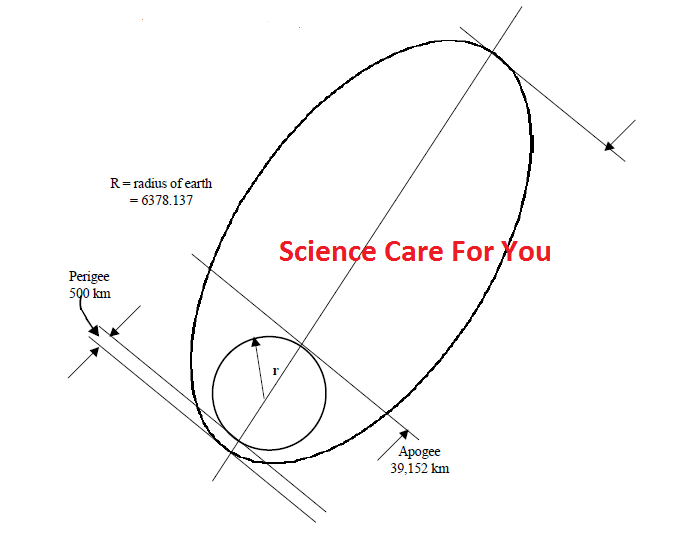
A satellite in an elliptical orbit around the earth has an apogee of 39,152 km and a perigee
of 500 km. What is the orbital period of this satellite? Give your answer in hours.

 Note: assume the average radius of the earth is 6,378.137 km and Kepler’s constant has the value 3.986004418x10^5 km^3/s^2.


Solution


Kepler’s three laws of planetary motion are

1. The orbit of any smaller body about a larger body is always an ellipse, with the
center of mass of the larger body as one of the two foci.

2. The orbit of the smaller body sweeps out equal areas in time (see Fig).

3. The square of the period of revolution of the smaller body about the larger body
equals a constant multiplied by the third power of the semimajor axis of the
orbital ellipse.

Want to know more About Kepler's Planetary Motion Click Here 


The mathematical formulation of the third law is T^2 = (4pi^2a^3)/m, where T is the orbital period, a is the semimajor axis of the orbital ellipse, and m is Kepler’s constant.

The perigee of a satellite is the closest distance in the orbit to the earth; the apogee of a
satellite is the furthest distance in the orbit from the earth.


The semimajor axis of the ellipse = (39,152 + (2x6378.137) + 500)/2 = 26,204.137 km

The orbital period is T^2 = (4pi^2a^3)/m = (4pi^2(26,204.137)^3)/ 3.986004418x10^5 = 1,782,097,845.0.

Therefore, T = 42,214.90075 seconds = 11 hours 43 minutes 34.9 seconds
Thursday

Chapter- 2(Lecture-3) Maximum Frequency Range, Doppler effects and Maximum Doppler Shift [Satellite Communication Engineering].

Discussion

This question is as same as question 2 of chapter 2 in satellite communication Engineering (322 km circular orbit) carries a 300 MHz transmitter.

a. Determine the maximum frequency range over which the received signal would shift
due to Doppler effects if received by a stationary observer suitably located in space.

Note: the frequency can be shifted both up and down, depending on whether the satellite
is moving towards or away from the observer. You need to determine the maximum
possible change in frequency due to Doppler (i.e. 2Df).

b. If an earth station on the surface of the earth at mean sea level, 6,370 km from the
center of the earth, can receive the 300 MHz transmissions down to an elevation angle of
0^o, calculate the maximum Doppler shift that this station will observe.

 Note: Include the earth’s rotation and be sure you consider the maximum possible Doppler shift for a 322 km circular orbit.

Solution

a. The highest Doppler shift would be observed in the plane of the satellite at the orbital
height of the satellite: the satellite would be coming directly at the observer or directly
away from the observer. The maximum Doppler shift would therefore be the sum of
these two values.

From eqn. (2.5), the orbital velocity v = (m/r)^1/2 = (3.986004418x10^5 / 6700.137)^1/2 =7.713066 km/s = 7,713.066 m/s.

The orbital velocity was calculated in question 2 as 7,713.066 m/s.
Using equation (2.44a), Df / fT = VT / vp , where Df is the Doppler frequency, fT is the
frequency of the transmitter at rest, VT is the component of the transmitter’s velocity
directed at the observer, and vp is the phase velocity of light. Since the observer is at
orbital height, the component of the transmitter’s velocity towards the observer is the
actual velocity of the satellite. 

Thus Df = (7,713.066x300,000,000) / 2.9979x10^8 =7,718.468928 Hz.
 The maximum Doppler shift therefore = 7,718.468928x2 =15,436.93786 Hz = 15,436.94 Hz.

b. It is best to draw a diagram to see what the set up looks like. Below is a view from
above the orbit of the satellite (orthogonal to the orbital plane).

The important element in this part of the question is the component of the satellite’s
velocity towards the earth station.


Summary: After Completion of this lecture you will be able to Determine the maximum frequency range over which the received signal would shift due to Doppler effects if received by a stationary observer suitably located in space, other than that also able to calculate the maximum Doppler shift that this station will observe, So stay tuned for more.

Sunday

Chapter- 2(Lecture-2) Satellite Communication Engineering.


Discussion

A satellite is in a 322 km high circular orbit. Determine:

a. The orbital angular velocity in radians per second;

b. The orbital period in minutes; and

c. The orbital velocity in meters per second.

Note: assume the average radius of the earth is 6,378.137 km and Kepler’s constant has
the value 3.986004418x10^5 km^3/s^2.


Solution

It is actually easier to answer the three parts of this question backwards, beginning with
the orbital velocity, then calculating the period, and hence the orbital angular velocity.
First we will find the total radius of the orbit r = 322 + 6,378.137 km = 6700.137 km


(c) From eqn. (2.5), the orbital velocity v = (m/r)^1/2 = (3.986004418x10^5 / 6700.137)^1/2 =7.713066 km/s = 7,713.066 m/s.

(b) From eqn. (2.6), T = (2pir^3/2)/(m^1/2) = (2pi6,700.137^3/2)/( 3.986004418x10^5)^1/2 =
(3,445,921.604)/(631.3481146) = 5,458.037372 seconds = 90.9672895 minutes = 90.97
minutes.

(a) The orbital period from above is 5,458.037372 seconds. One revolution of the earth
covers 360^o or 2pi radians. Hence 2pi radians are covered in 5,458.037372 seconds,
giving the orbital angular velocity as 2pi/5,458.037372 radians/s = 0.0011512 radians/s.
An alternative calculation procedure would calculate the distance traveled in one orbit
(2pir = 2pi6700.137 = 42,098.20236 km). This distance is equivalent to 2pi radians and so 1 km is equivalent to 2pi/42,098.20236 radians = 0.0001493 radians. From above, the
orbital velocity was 7.713066 km/s = 7.713066x0.0001493 radians/s = 0.0011512
radians/s.

Summary: After completion of this lecture you will be able to calculate Orbital Velocity in meter per second, Orbital Period in minutes and Orbital Angular Velocity in radian per second Mathematically.

Saturday

Chapter- 2(Lecture-1) Satellite Communication Engineering


Discussion


Explain what the terms centrifugal and centripetal mean with regard to a satellite in orbit
around the earth.

A satellite is in a circular orbit around the earth. The altitude of the satellite’s orbit above the surface of the earth is 1,400 km.
(i) What are the centripetal and centrifugal accelerations acting on the satellite in its orbit? Give your answer in m/s^2. 

(ii) What is the velocity of the satellite in this orbit? Give your answer in km/s. 

(iii) What is the orbital period of the satellite in this orbit? Give your answer in hours, minutes, and seconds.

 Note: assume the average radius of the earth is 6,378.137 km and Kepler’s constant has the value 3.986004418x10^5 km^3/s^2


Solution

In the case of a satellite orbiting the earth, the centrifugal force on the satellite is a force on the satellite that is directly away from the center of gravity of the earth (FOUT) and the centripetal force is one directly towards the center of gravity of the earth (FIN). The centrifugal force on a satellite will therefore try to fling the satellite away from the earth while the centripetal force will try to bring the satellite down towards the earth.

(i) From equation (2.1) centripetal acceleration a = m/r^2, where m is Kepler’s constant.
The value of r = 6,378.137 + 1,400 = 7,778.137 km, thus a = 3.986004418x10^5 /
(7,778.137)^2 = 0.0065885 km/s^2 = 6.5885007 m/s^2. From equation (2.3), the centrifugal
acceleration is given by a = v^2/r, where v = the velocity of the satellite in a circular orbit..
From equation (2.5) a = (v/r)^1/2 = (3.986004418x10^5 / 7,778.137)^1/2 = 7.1586494 km/s
and so a = 0.0065885007 km/s^2 = 6.5885007 m/s^2.

 NOTE: since the satellite was in stable orbit, the centrifugal acceleration must be equal to the centripetal acceleration,which we have found to be true here (but we needed only to calculate one of them).


(ii) We have already found out the velocity of the satellite in orbit in part (i) (using
equation (2.5)) to be 7.1586494 km/s

(iii) From equation (2.6), the orbital period T = (2pir^3/2)/(v^1/2) = (2pi7,778.137^3/2)/(
3.986004418x10^5)^1/2 = (4,310,158.598)/(631.3481146) = 6,826.912916 s = 1 hour 53
minutes 46.92 seconds

Summary: So after completion of this lecture you will be able to understand the terms centrifugal and centripetal mean with regard to a satellite in orbit around the earth, then we mathematically proved the centripetal and centrifugal accelerations acting on the satellite in its orbit, we also proved mathematically orbital period of the satellite in this orbit then we derived mathematical expression orbital period of the satellite in this orbit?, answer in hours, minutes, and seconds.

Wednesday

Satellite Communication System Engineering whole Syllabus and E-Books (Download).


Lecture 1 INTRODUCTION AND
BACKGROUND(Origin of
satellite Communications)

Description

Origin of satellite
Communications

Why and when satellite
communications has


started

Lecture 2 INTRODUCTION AND
BACKGROUND(Active and
Passive satellites)

INTRODUCTION AND
BACKGROUND(Different orbits
for different missions.)

INTRODUCTION AND
BACKGROUND(Advantages and
disadvantages of Satellite
communications.)

Description

Active and Passive
satellites

Classification on basis
of passive reflection or
active electronics
system

Different orbits for
different missions

How LEO, GEO can be
used for different
applications

Advantages and
disadvantages of Satellite
communications

benefits of using
satellite
communications


Lecture 3 INTRODUCTION AND
BACKGROUND(Frequency
Allocations for satellite services.)
ORBITAL MECHANICS
(Introduction)

Description

Frequency Allocations
for satellite services

Why and which
frequency band is used
for satellite
communications

Developing the
equations of orbit

Mathematical
description of orbits

Lecture 4 ORBITAL MECHANICS
(Introduction)
ORBITAL MECHANICS(Kepler's
three laws of planetary motion.)

Description

Developing the
equations of orbit

Mathematical
description of orbits

Keplers three laws ,
describing the orbit of a
satellite, locating
satellite in orbit, locating
the satellite wuth respect
to earth, orbital elements
How Keplers law can
be derived

Lecture 5 ORBITAL MECHANICS(Kepler's
three laws of planetary motion.)

Keplers three laws ,
describing the orbit of a
satellite, locating
satellite in orbit, locating
the satellite wuth respect
to earth, orbital elements
How Keplers law can
be derived


Lecture 6 ORBITAL MECHANICS(Kepler's
three laws of planetary motion.)


Keplers three laws ,
describing the orbit of a
satellite, locating
satellite in orbit, locating
the satellite wuth respect
to earth, orbital elements

How Keplers law can
be derived

Lecture 7 ORBITAL MECHANICS(Look
Angle Determination.)


Description


Look Angle
Determination

How subsatellite point,
elevation angle and
azimuthal angle can be
calculated

Lecture 8 ORBITAL MECHANICS(Orbital
Perturbations.)


Description


Longitudinal Changes,
Inclination Changes

How earths oblateness,
sun and moon effect the
earths orbit


Lecture 9 SATELLITE SUB SYSTEMS
AND SATELLITE EARTH
STATIONS.(Satellite subsystems.)


Description


Introduction to satellite
communications

Overview of Various
subsystems


Lecture 10 SATELLITE SUB SYSTEMS
AND SATELLITE EARTH
STATIONS.(Altitude and Orbit
Control System.)


Description

Altitude and Orbit
Control System

How the altitude of
orbit of the satellite can
be controlled

Lecture 11 SATELLITE SUB SYSTEMS
AND SATELLITE EARTH
STATIONS.(Telemetry.)


SATELLITE SUB SYSTEMS
AND SATELLITE EARTH
STATIONS.(Tracking.)

SATELLITE SUB SYSTEMS
AND SATELLITE EARTH
STATIONS.(Monitoring.)

Description


Telemetry

Tracking

Monitoring

How to send the data
related to satellites

How to determine the
current orbit of the
satellite

Monitoring of the
satellites subsytems
temperature, pressure in
fuel tanks,

Lecture 12 SATELLITE SUB SYSTEMS
AND SATELLITE EARTH
STATIONS.(Power systems.)


Description


Power systems

How the electrical
power is obtained

Lecture 13 SATELLITE SUB SYSTEMS
AND SATELLITE EARTH
STATIONS.(Communications
subsystems.)


SATELLITE SUB SYSTEMS
AND SATELLITE EARTH
STATIONS.(Satellite antennas and
Satellite Earth Stations)

SATELLITE TRAJECTORIES
(Orbit effects in communication's
system performance.)

Description


Communications
subsystems

Satellite antennas

orbital effects

Description of
communications system

description of wire,
horn , reflector, and
array antennas

effects on orbits due to
sun, moon and earth


Lecture 14 SATELLITE TRAJECTORIES
(Launches and Launch vehicles.)


Description


Launches and Launch
vehicles

Learning about launch
vehicles

Lecture 15 SATELLITE TRAJECTORIES
(Placing satellites into
geostationary orbit.)


Description


Placing satellites into
geostationary orbit

How to place satellites
into geostationary orbit

Lecture 16 MODULATION USED IN
SATELLITE LINKS(Analog and
Digital Modulation for satellite
links.)


Description


Analog and Digital
Modulation for satellite
links

analog and digital
modulation used in
satellite
communications

Lecture 17 MODULATION USED IN
SATELLITE LINKS(Frequency
modulation.)


Description


Frequency modulation

analogmodulation used
in satellite
communications

Lecture 18 MODULATION USED IN
SATELLITE LINKS(BPSK
Modulation)


Description


BPSK Modulation

digital modulation used
in satellite
communications

Lecture 19 MODULATION USED IN
SATELLITE LINKS(QPSK
Modulation.)


Description


QPSK Modulation,

digital modulation

Lecture 20 MODULATION USED IN
SATELLITE LINKS(QAM
Modulation.)


Description


QAM Modulation

digital modulation used
in satellite
communications

Lecture 21 MODULATION USED IN
SATELLITE LINKS(TDM
standards for satellite systems.)


Description


TDMA frame structure

Different TDM
standards used

Lecture 22 MICROWAVE LINK BUDGET
(Introduction)


Description


Introduction

Student will learn about
carrier to noise ratio of
downlink satellite
system


Lecture 23 MICROWAVE LINK BUDGET
(General link design equation)


Description


General link design
equation

Student will learn about
basic transmission
theory

Lecture 24 MICROWAVE LINK BUDGET
(System noise temperature)


Description


System noise
temperature

Student will learn about
concepts of the system
noise temperaure

Lecture 25 MICROWAVE LINK BUDGET
(Downlink design.)


Description


Downlink design

Student will learn about
carrier to noise ratio of
downlink satellite
system

Lecture 26 MICROWAVE LINK BUDGET
(Uplink design.)


Description


Uplink design

Student will learn to
design the uplink

Lecture 27 MICROWAVE LINK BUDGET
(Complete link design.)


Description


Complete link design

Student will learn to
Considering other
factors like effect of
rain in designing link

Lecture 28 MULTIPLE ACCESS
TECHNIQUES IN SATELLITE
COMMUNICATIONS(FDM -FMFDMA
-TDMA structure)


Description


FDM FM FDMA TDMA
structure

Multiple access
techniques will be
learnt by student

Lecture 29 MULTIPLE ACCESS
TECHNIQUES IN SATELLITE
COMMUNICATIONS(Onboard
Processing systems.)


Description


Onboard Processing
systems

Student will learn about
the onboard processing
systems

Lecture 30 MULTIPLE ACCESS
TECHNIQUES IN SATELLITE
COMMUNICATIONS(DAMA.)


MULTIPLE ACCESS
TECHNIQUES IN SATELLITE
COMMUNICATIONS(CDMAsystem
design and capacity.)

Description


DAMA

Student will learn about
the demand assigned
multiple access

CDMAsystem design
and capacity

Student will learn about
Code Division
Multiple Acccess

Lecture 31 ERROR CONTROL(Error
Correction.)


ERROR CONTROL(Error
detection.)

ERROR CONTROL(Channel
Capacity)

Description


Student will learn about
the techniques to
correct the errors

Student will learn about
the techniques to detect
the errors

Student will learn about
the capacity of the
system

Lecture 32 ERROR CONTROL(Error Control
Coding)


ERROR CONTROL(Performance
of Block Error Correction Codes)

ERROR CONTROL
(Convolutional Codes)

Description


Error Control Coding
Students will learn
about the techniques to
control the errors

Performance of Block
Error Correction Codes
(students will learn
about the performance
of Block error
Correction Codes)

Convolutional Codes
(Students will learn
about the concepts of
channel coding)


Lecture 33 ERROR CONTROL
(Implementation of Error detection
on satellite links.)


ERROR CONTROL(Concatenated
coding)

Description


Implementation of Error
detection on satellite
links

Students will learn
about the concepts
detect the errors

Students will learn
about the concatenated
coding


Lecture 34 ERROR CONTROL(Interleaving)


ERROR CONTROL(Turbo
Codes.)

Description


Interleaving

Student will learn about
to control errors

Turbo Codes

Student will learn about
the concepts of
controlling errors


Lecture 35 SATELLITE APPLICATIONS
(Satellites for weather forecast.)


SATELLITE APPLICATIONS
(Introduction.)

Description


Satellites for weather
forecast

Student will learn about
the applications of
satellites

Introduction to satellite
applications

Student will learn about
the applications of
satellites

Lecture 36 SATELLITE APPLICATIONS
(Satellite Applications in
Television and Telephone)


SATELLITE APPLICATIONS
(Data Communication Services.)

SATELLITE APPLICATIONS
(Satellites for earth observation)

Description


Satellite Applications in
Television and
Telephone

Student will learn about
the applications of
satellites

Data Communication
Services

Student will learn about
the applications of
satellites

Satellites for earth
observation

Student will learn about
the applications of
satellites

Lecture 37 GLOBAL POSITIONING
SATELLITE SYSTEMS AND
VSAT SYSTEMS.(The Technical
Structure)


GLOBAL POSITIONING
SATELLITE SYSTEMS AND
VSAT SYSTEMS.(Frequencies
used by GPS Satellites)

GLOBAL POSITIONING
SATELLITE SYSTEMS AND
VSAT SYSTEMS.(Types of GPS
Services)

GLOBAL POSITIONING
SATELLITE SYSTEMS AND
VSAT SYSTEMS.(GPS Position
Location Layout)

Description


Student will learn about
the technical structure
of GPS system

Frequencies used by GPS
Satellites

Student will learn about
Frequencies used by
GPS Satellites

GPS Position Location
Layout

Lecture 38 GLOBAL POSITIONING
SATELLITE SYSTEMS AND
VSAT SYSTEMS.(GPS Receiver)


GLOBAL POSITIONING
SATELLITE SYSTEMS AND
VSAT SYSTEMS.(Trilateration
Method)

Description


Student will learn about
GPS receiver

Student will learn about
how to find the position
of satellite using Trilateration Method

Lecture 39 GLOBAL POSITIONING
SATELLITE SYSTEMS AND
VSAT SYSTEMS.(Signal
Acquisition by GPS Receiver)


GLOBAL POSITIONING
SATELLITE SYSTEMS AND
VSAT SYSTEMS.(Introduction to
VSAT systems)

GLOBAL POSITIONING
SATELLITE SYSTEMS AND
VSAT SYSTEMS.(Introduction to
VSAT architectures.)

Description


Signal Acquisition by
GPS Receiver

Introduction to VSAT
systems


Best Suggested text books for the satellite communication covering Whole syllabus-


1. Satellite Communications Timothy Pratt, Charles W.
Bostian, Jeremy E. Alnutt 2nd edition of year 2007 wiley publisher.

2. Satellite Communications D.C. Agarwal, A.K. Maini,
Ashok Raj 6th edition of year 2006 khanna publisher

3. Satellite Communication System
Engineering
W.L.Pritchard,H G
Suyderhoud and R A
Nelson. 2nd edition of year 1993 prentice hall


Blog Archive